Material comparisons often begin with a simplified contest: steel is strong, aluminium is light and carbon fibre is advanced. Each description contains something useful, but none is sufficient to select a yacht. The relevant question is how the completed structure performs for its intended duty, and what the builder must control to produce it consistently.
Hull form, structural arrangement, equipment weight and operating speed interact. A lighter structure may allow different performance or payload choices, but those gains can be consumed by larger machinery, extensive glazing or heavy interior features. Compare the whole weight budget and the specified operating condition rather than a material label in isolation.
Steel: structure and protection
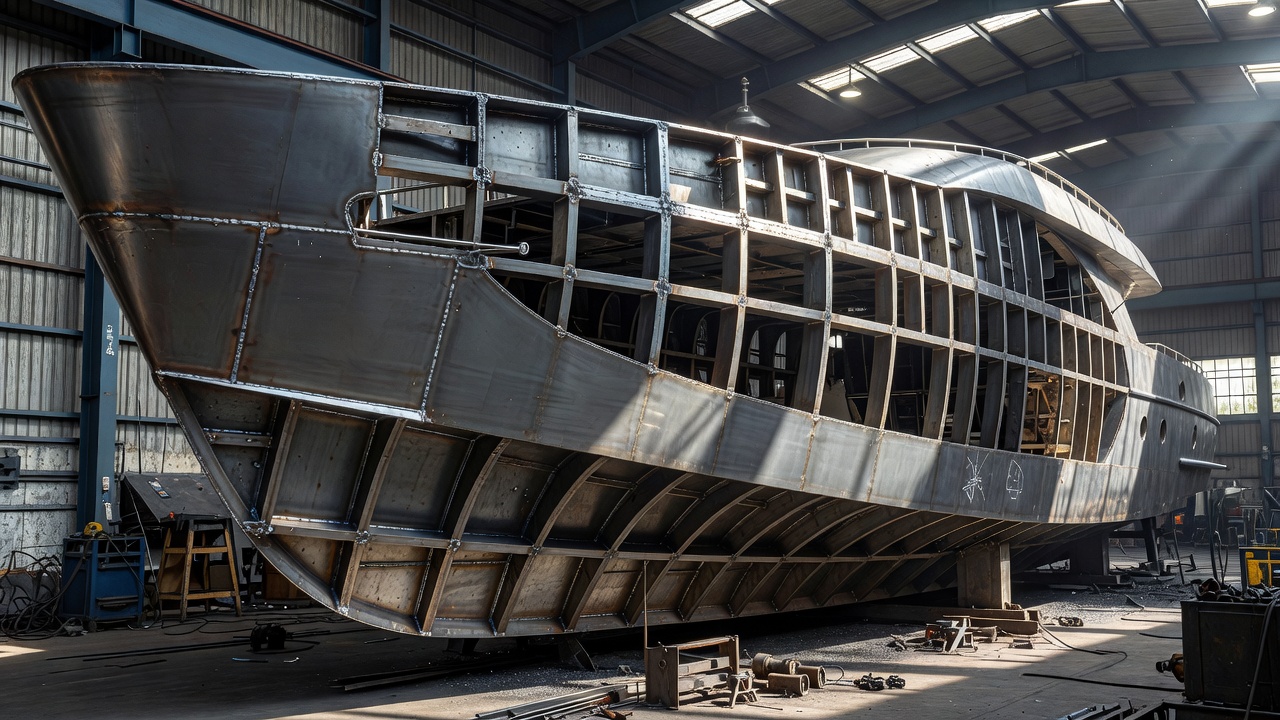
Steel remains important in larger displacement motor yachts. Its fabrication methods are well established, and its mechanical properties support a wide range of structural arrangements. Repair expertise is available in many commercial shipbuilding regions, although access to yacht-standard finishing and specialist systems should never be assumed merely because a port can weld steel.
The material requires a coherent corrosion-control strategy. Coating preparation, drainage, access to enclosed spaces and inspection arrangements deserve attention before the interior conceals the structure. A researcher should ask about the coating specification, records of preparation and application, and practical access for future maintenance. These questions are more useful than asking whether steel “rusts,” because exposure and protection are part of the engineered system.
A steel hull may be paired with an aluminium superstructure to manage weight higher in the vessel. The interface needs appropriate engineering, including the connection method and protection against galvanic corrosion. Different materials in one yacht do not automatically imply compromise; they create specific design and workmanship obligations.
Aluminium: weight with conditions
Aluminium alloys offer a lower density than steel, but a hull is not designed by exchanging equal-thickness plates. Stiffness, fatigue behaviour, weld details and local loads influence structural dimensions. Qualified fabrication and welding procedures matter, as do distortion control and inspection. Weight advantages must be assessed at the completed-structure level.
Heesen is a useful manufacturer reference for aluminium motor yacht construction. Royal Huisman provides another perspective through custom sailing projects. These examples show that a material can support different missions; they do not mean that every project from either yard shares an identical construction specification.
Fire protection, electrical isolation and contact with dissimilar metals require deliberate treatment. The appropriate arrangements depend on the yacht and its applicable rules. Owners should seek documented systems and maintainable installations, not rely on broad claims that a particular metal is maintenance-free.
Composites: a manufactured system
A fibre-reinforced composite combines reinforcement with a resin matrix; many structures also use a core between skins. Glass fibre and carbon fibre are not interchangeable marketing grades. Fibre direction, laminate schedule, resin choice, core details and manufacturing quality determine the resulting structure. Local reinforcement around fittings can matter as much as the broad material description.
Production methods can include hand lay-up, infusion and processes using pre-impregnated reinforcement. Each has its own controls for material handling, consolidation and cure. Ask what is actually specified for the hull, deck, superstructure and structural components rather than assuming a headline term describes the entire yacht.
Baltic Yachts is a relevant reference for advanced composite sailing construction. Series motor yacht manufacturers such as Princess provide a different industrial context for composite production. Neither reference establishes that one construction route is universally preferable: tooling investment, repeatability, project complexity and intended performance change the comparison.
Compare controls, not adjectives
| Construction | Evidence to request | Lifecycle question |
|---|---|---|
| Steel | Material certificates, welding and coating records | Can protected spaces be inspected and maintained? |
| Aluminium | Alloy specification, welding procedures, isolation details | Who can perform appropriate structural repairs? |
| Composite | Laminate specification, production controls, inspection records | How are damage assessment and repairs documented? |
Technical rules help define requirements, but their application is project-specific. Lloyd's Register, RINA and DNV publish information about maritime classification and technical services. A society's name on a presentation is not enough: confirm the intended notation, applicable rules, survey scope and status of the particular vessel.
The maintenance comparison should include the systems attached to the structure. Access behind interior panels, drainage, leak detection, fastener choices and records of modifications can influence serviceability regardless of hull material. In a pre-owned yacht, a competent independent survey is more valuable than an abstract preference for steel, aluminium or composite.
Finally, environmental claims need a defined boundary. Manufacturing energy, material origin, operating profile, repairability and end-of-life routes are different measures. A lower structural weight does not by itself prove a lower lifecycle impact. Ask for a stated methodology before accepting a broad claim that one yacht is inherently sustainable.
Next: Production Routes